Three complaints come up more than any others in Mississauga’s subdivision housing, and they’re all the same problem wearing different clothes:
- “The bedroom over the garage is freezing no matter what I do.”
- “The floor under the breakfast nook is like ice in January.”
- “The basement is finished but it’s always cold and the first floor is draughty.”
None of these is a thermostat problem, a furnace problem, or something more attic insulation will fix. They’re all floors and framing exposed to outside air, insulated at construction with fibreglass batts that don’t stop air movement.
Spray foam is genuinely the right tool for all three. Here’s why, and what to ask for.
Why batts fail in these specific spots
Batts work reasonably well in a wall cavity that’s sealed on both sides, warm on one face and protected on the other.
They fail when the cavity is open to moving cold air. Air passes around them, through the gaps at every edge, and past every wire and pipe. The fibreglass is still there, still nominally R-14 or R-20, and the room above is still cold — because the heat isn’t leaving by conduction. It’s leaving by air movement, which batts don’t address.
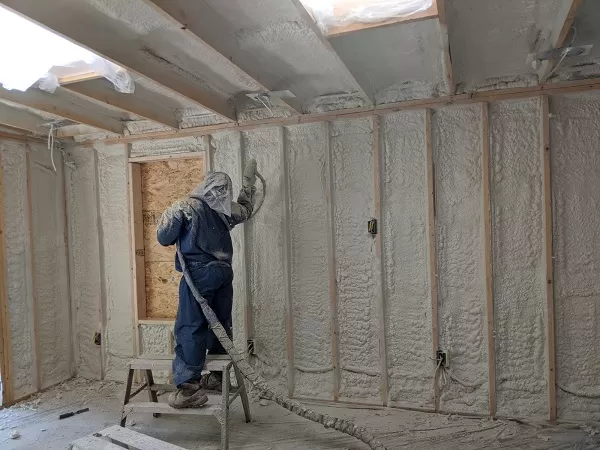
Closed-cell spray foam adheres directly to the framing and the sheathing. There’s no gap for air to move through, because the insulation is bonded to every surface.
That’s the whole distinction, and it explains all three problems.
The two products, quickly
| ½ lb open-cell | 2 lb closed-cell | |
|---|---|---|
| Approx. R per inch | ~R-3.5 – R-3.8 | ~R-6.0 – R-7.0 |
| Structure | Soft, flexible | Rigid, dense |
| Own vapour barrier? | No | Yes, at sufficient thickness |
| Handles moisture | Absorbs water | Resists water |
| Sound dampening | Better | Poorer |
| Relative cost | Lower | Higher |
Everything in this article is closed-cell. These are all cold, exterior-facing assemblies where moisture control and R-value per inch both matter.
Open-cell has a real role in Mississauga homes — sound between floors, home offices, media rooms, interior partitions in a basement finish — just not for these problems.
½ lb low-density → · 2 lb high-density →
Problem 1: The room above the garage
The most common comfort complaint in Mississauga housing, and the clearest case for spray foam anywhere in the home.
What’s there now: fibreglass batts pushed up into the joist cavities of the garage ceiling, usually held by the drywall below. Sometimes with a poly vapour barrier, often without. The garage is unheated and, every time the door opens, it fills with outside air.
Why it fails: the batts don’t seal. Cold air moves around them and through the joist bays. The subfloor above stays cold, and the room sits on a cold surface all winter. Warm air from your furnace can’t overcome a permanently chilled floor.
Why the usual fixes don’t work:
- Adding a second layer of batts — same air movement, slightly more R-value, marginal difference
- Turning up the thermostat — heats the rest of the house, not the floor
- A space heater — treats the symptom, forever
- Closing the vents elsewhere — makes other rooms worse
What actually works:
- Remove the garage ceiling drywall
- Remove the existing batts
- Spray closed-cell foam into the joist cavities, sealing the perimeter and every penetration
- Reinstate 5/8″ fire-rated drywall — required between an attached garage and the dwelling
It’s more invasive than homeowners expect, and it’s the only version that reliably delivers. Anyone offering to fix a cold bonus room without opening the garage ceiling is selling you something that won’t work.
Garage ceiling insulation → · 5/8″ fire-rated drywall →
Problem 2: The cantilever nobody thinks about
This one is rarely discussed and extremely common in Mississauga’s subdivision stock.
A cantilever is any part of your floor that projects out beyond the wall below it. In production housing that usually means:
- A bumped-out breakfast nook or dinette off the kitchen
- A bay window with floor area, not just glass
- A second-floor bedroom overhanging the garage door opening
- A projecting fireplace or media wall
The floor of that bump-out has outside air underneath it, and often on three sides. It’s effectively a small piece of exterior wall turned horizontal.
What builders typically do: stuff batts into the joist bays and close it up with soffit material underneath. The perimeter is rarely sealed, and the joist bays frequently run straight back into the heated floor structure — which means outside air travels inward under your floor.
The result: a room with a floor that’s cold in a strip, or a specific corner of the house that never feels right, and nobody can work out why. It gets blamed on windows, on the furnace, on the HVAC balance. It’s the cantilever.
The fix: open the underside, remove the batts, spray closed-cell foam to seal the cavity and — critically — block the joist bays where they pass from outside to inside, so air can’t track back under the heated floor.
Small area. Disproportionate result. Frequently the cheapest meaningful comfort improvement in a suburban home.
Problem 3: The rim joist and the cold finished basement
The rim joist is the band of framing running around the top of your foundation wall, where the floor structure sits. In most Mississauga homes it holds a friction-fit scrap of fibreglass and nothing else.
It’s a continuous air leak around the entire perimeter of the house. Cold air enters, travels through the floor structure, and shows up as a draughty basement and a cold first floor.
If your basement is already finished, the rim joist is usually still accessible above the drop ceiling or behind the mechanical room — worth checking before assuming it’s a bigger job than it is.
Closed-cell foam seals and insulates it in one pass, and it’s a small area relative to the effect.
Two related items while the crew is there:
- Basement walls — if you’re finishing or refinishing, foam applied directly to the foundation wall insulates and controls vapour in one operation, rather than framing and filling with batts and hoping the vapour strategy holds. Vapour barrier installation →
- The cold room / cantina under the front porch — usually deliberately unheated and vented, and the ceiling between it and the house above is frequently under-insulated
Rebate note: foundation header, basement wall and crawlspace insulation each carry their own rebate amounts under the program’s bundled path. If you’re doing more than one, that matters. Mississauga rebate guide →
Where we’ll tell you not to use spray foam
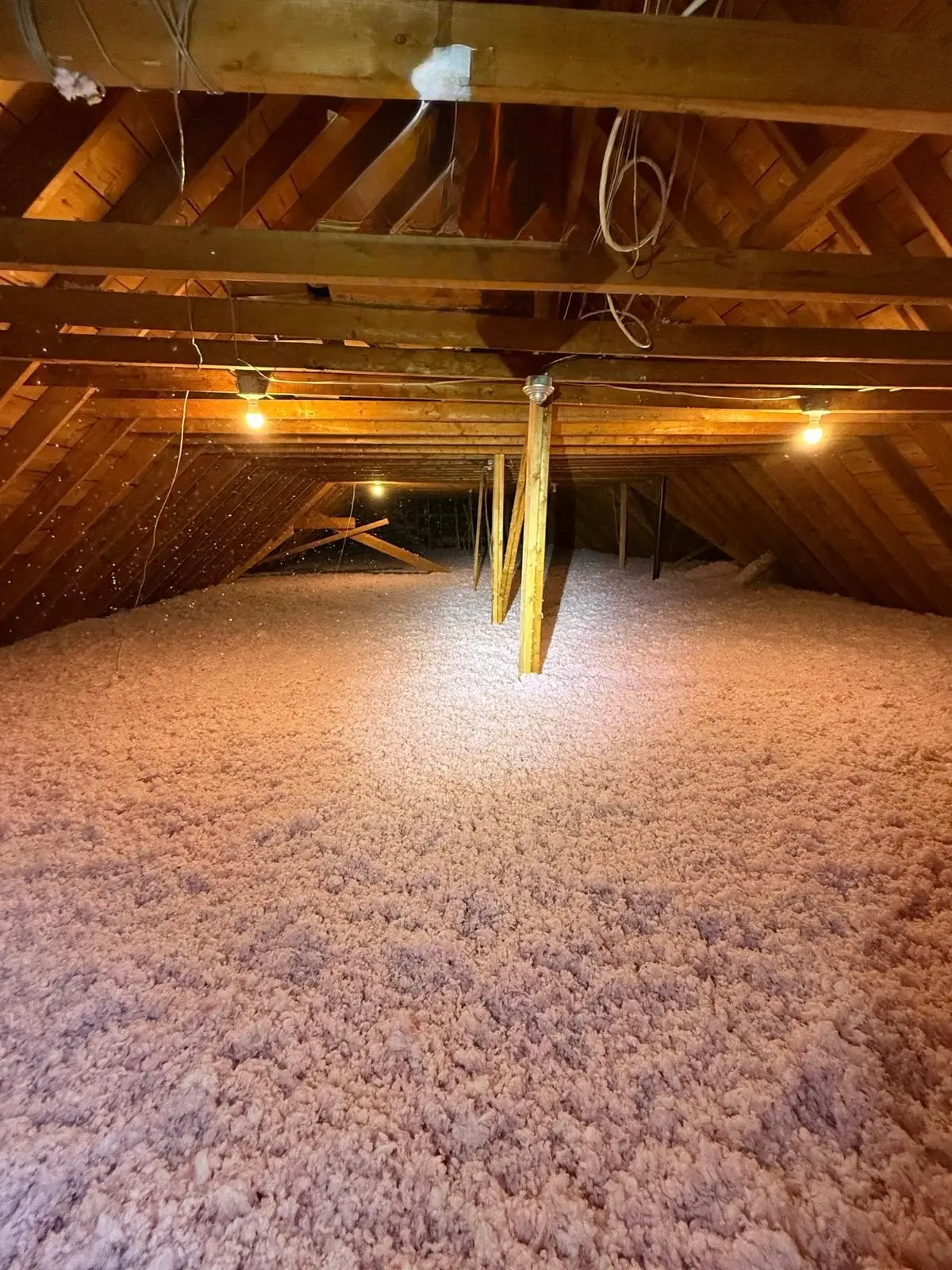
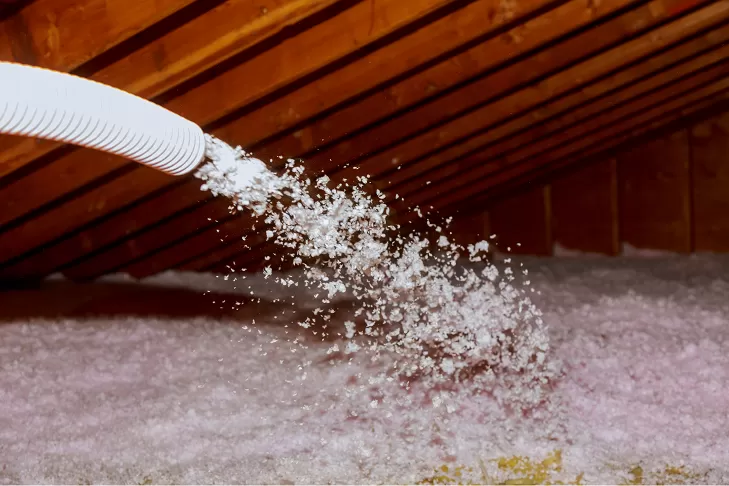
Your attic. If you have a standard truss attic with headroom — which most Mississauga homes do — blown-in cellulose or fibreglass reaches R-60 for considerably less. We install both and we’ll say so. Attic insulation in Mississauga →
Interior walls where the goal is quiet. Acoustic mineral wool typically performs better for sound, at lower cost. Safe and Sound →
As a substitute for diagnosis. A hot upstairs caused by undersized return ducts, ice dams caused by buried soffit vents, a damp basement caused by grading and downspouts — foam solves none of these. Be wary of anyone who arrives with one product and finds a use for it in every room.
Practical questions
Do I need to leave the house? We install Insulthane Extreme by Elastochem and residents can generally remain in the home. We’ll discuss ventilation and re-entry timing for the specific area, and if anyone in the household has significant respiratory sensitivities, tell us in advance.
How long does a garage ceiling take? It’s a multi-stage job — drywall removal, foam, then re-drywall, tape and finish. We’ll give you the schedule at quote stage, since the drywall finishing drives most of the timeline.
Do I have to re-drywall the garage ceiling? Yes. Fire separation between an attached garage and the living space is required, and the foam has to be covered.
Can spray foam be removed later? Not easily — it bonds permanently. Worth being confident about the application before committing.
Will this actually fix my cold bonus room? Air sealing the garage ceiling addresses the dominant cause. If the room also has poor supply air, an exposed cantilever, or large exterior wall area, those need addressing too. That’s what the assessment is for — we’d rather identify all of it up front than fix one thing and have you still be cold.
Does spray foam qualify for the Ontario rebate? Rebates are based on the R-value increase and the area covered, not the material. Foam qualifies where it meets the thresholds for that assembly. The rebate is capped at a share of project cost, which affects the arithmetic on a higher-cost material.
⚠️ Program terms change — confirm at homerenovationsavings.ca.
How we quote
- On-site assessment. We look at the actual assembly — garage ceiling, cantilever underside, rim joist, basement. No phone quotes on foam.
- The quote names the product and the applied thickness — open-cell or closed-cell, and how many inches. That’s what makes competing bids comparable.
- Fixed price, stated up front.
- If foam is the wrong answer, we say so. We install blown-in, batt, drill and fill and mineral wool as well, so we have no reason to push the expensive option.
📞 (416) 315-0471 · Book a free assessment →